
What Is Mold Cavity Engraving? How Do Different Processes Impact Your Products?
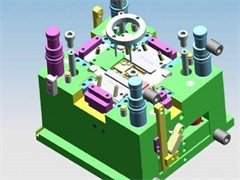
For manufacturers relying on injection molding—whether for automotive parts, consumer electronics, or medical devices—mold cavity engraving is more than a finishing step: it’s the key to defining product quality, functionality, and market competitiveness. If you’re sourcing molds for overseas markets, understanding how engraving processes affect your end products will help you make smarter decisions, reduce production delays, and avoid costly reworks.
1. What Exactly Is Mold Cavity Engraving?
Mold cavity engraving refers to the precision machining of patterns, textures, logos, or functional details on the inner surface of an injection mold’s cavity. When plastic is injected into the mold, these engraved features transfer directly to the final product—making the process critical for:
- Aesthetic appeal: Creating matte finishes, brand logos, or decorative textures (e.g., soft-touch surfaces on phone cases).
- Functional performance: Adding grip patterns (for tools), vent holes (to prevent air bubbles), or alignment marks (for assembly).
- Regulatory compliance: Engraving part numbers, material codes, or safety certifications (required in industries like automotive and medical).
2. 3 Common Mold Cavity Engraving Processes (And Their Pros & Cons)
Not all engraving methods work for every project. Below are the three most widely used processes in global manufacturing, along with their ideal use cases—so you can match the right technique to your product needs.
2.1 Laser Engraving: Fast, Precise, and Versatile
How it works: Uses a high-powered laser beam to etch patterns onto the mold surface, with computer control (CNC) ensuring micron-level accuracy. Our in-house patented laser engraving systems (compliant with ISO 9001 standards) can handle even complex 3D cavity shapes.
Key advantages:
- Ultra-fine detail (down to 0.01mm) for intricate designs (e.g., micro-textures on medical device molds).
- No physical contact with the mold—avoids tool wear and damage to delicate mold materials (e.g., P20 steel).
- Fast turnaround: Completes small-batch engraving in 2–4 hours (vs. 1–2 days for traditional methods).
Best for: High-precision products (electronics, medical parts), custom logos, or low-to-medium volume production runs.
2.2 MasterCAM Projection Machining: Reliable for Large-Scale Production
How it works: Combines MasterCAM software (a global industry standard) with CNC milling to “project” 2D/3D designs onto the mold cavity. The process uses rotating cutting tools to carve features, with real-time feedback ensuring consistency across multiple molds.
Key advantages:
- Exceptional repeatability: Ideal for mass production (e.g., 1000+ mold sets for automotive components).
- Handles deep engraving (up to 5mm) for functional features like ribs or grooves.
- Compatible with all common mold materials (steel, aluminum, copper).
Best for: High-volume manufacturing, large mold cavities (e.g., appliance housings), or parts requiring deep, durable engravings.
2.3 EDM (Electrical Discharge Machining): Perfect for Hard Materials
How it works: Uses electrical sparks to erode the mold surface (instead of physical cutting), making it suitable for ultra-hard materials like H13 steel (used in high-temperature injection molding).
Key advantages:
- No tool pressure: Prevents deformation of hard, brittle molds.
- Creates sharp, clean edges (critical for parts like plastic gears or precision valves).
Tradeoff: Slower than laser engraving (takes 1–3 days for complex designs) and higher cost per mold.
Best for: High-wear molds (e.g., those using glass-filled plastics) or parts requiring tight tolerances (aerospace components).
3. How Engraving Processes Impact Your Product—By the Numbers
Choosing the wrong process isn’t just a technical issue—it directly affects your bottom line. Here’s how different methods influence key metrics:
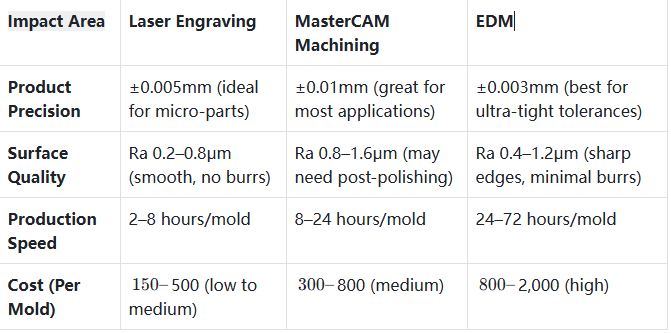
Example: A client manufacturing 50,000 plastic toy parts monthly switched from EDM to laser engraving for their mold logos. They reduced mold lead time by 3 days and cut engraving costs by 40%—without sacrificing logo clarity.
4. How to Choose the Right Process for Your Overseas Project
Follow these 3 steps to align your engraving method with your product goals and market requirements:
Step 1: Start with Your Product Specifications
- If your product needs fine details (e.g., a 0.5mm brand logo on a USB drive), laser engraving is the best fit.
- If you’re producing 10,000+ units/month (e.g., automotive interior trim), MasterCAM machining balances speed and cost.
- If your mold uses hard materials (e.g., H13 steel for high-heat plastics), EDM avoids tool damage.
Step 2: Check Material Compatibility
Not all processes work with every mold material. For example:
- Aluminum molds (lightweight, low-cost) pair well with laser engraving or MasterCAM machining.
- Stainless steel molds (corrosion-resistant, used in food packaging) require EDM or high-power laser systems.
Step 3: Factor in Overseas Lead Times
Overseas clients often face tighter shipping schedules. Laser engraving’s fast turnaround (2–4 hours for small designs) can help you meet delivery deadlines, while EDM may require adding 3–5 days to your production timeline.
5. Why Partner with a Supplier Experienced in Overseas Mold Engraving?
When selling to global markets, your mold supplier needs more than technical skill—they need to understand international standards:
- Compliance: Our engraving processes meet ASTM (U.S.), DIN (Europe), and JIS (Japan) standards, ensuring your products pass regional inspections.
- Communication: We provide 24/7 English support and share real-time CNC progress reports (via Slack or email) so you stay updated, even across time zones.
- Quality Control: Every engraved mold undergoes 3D scanning (using Zeiss measuring tools) before shipping—so you receive a mold that’s ready to use, no reworks needed.
Final Thoughts
Mold cavity engraving isn’t a “one-size-fits-all” process. By matching the right technique to your product’s precision needs, material, and production volume, you’ll create higher-quality products, reduce costs, and gain an edge in overseas markets.
Ready to discuss your project? Send us your product drawings or specifications, and our engineering team will recommend the best engraving solution—with a detailed quote and lead time breakdown.